ARTIST · ATLANTA
Tommy Hoppe
Artist and theorist working across graphite drawing, large scale color painting, and written theory.

About
Tommy Hoppe makes drawings, paintings, and working systems that bring color, music, geometry, and human perception into the same field.
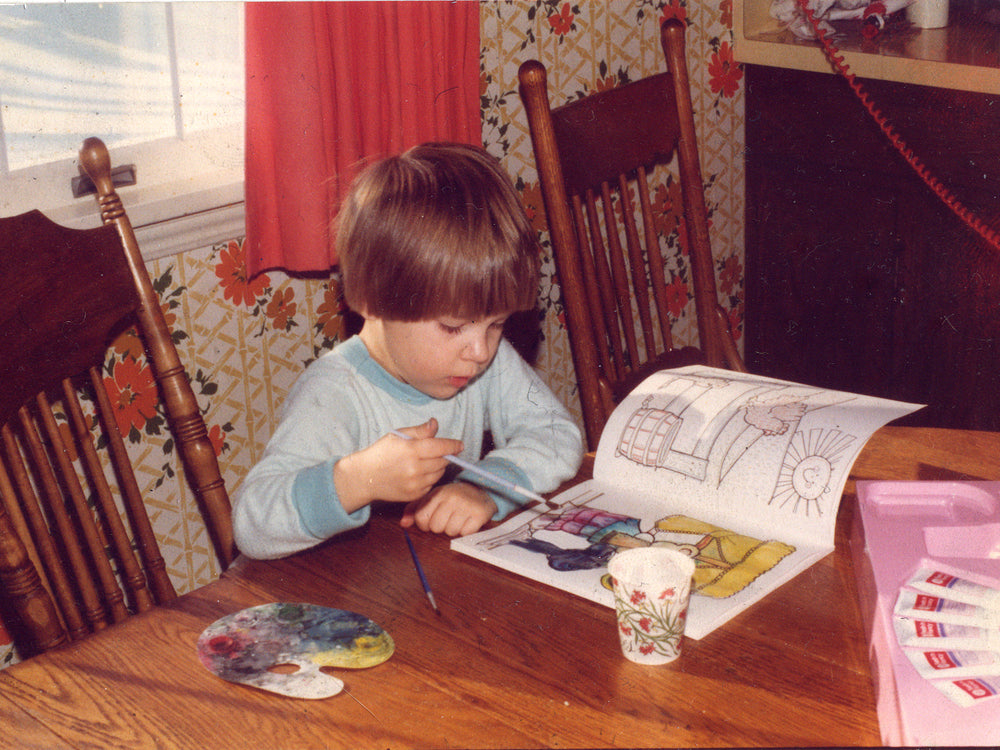
Born in Melbourne and raised between England and upstate New York, Hoppe has been drawing for longer than he can remember. Childhood was organized around museums, independent art study, architecture, mechanical drawing, and Euclidean geometry. By the time he entered college, drawing was not a subject he had chosen. It was already the way he understood the world.
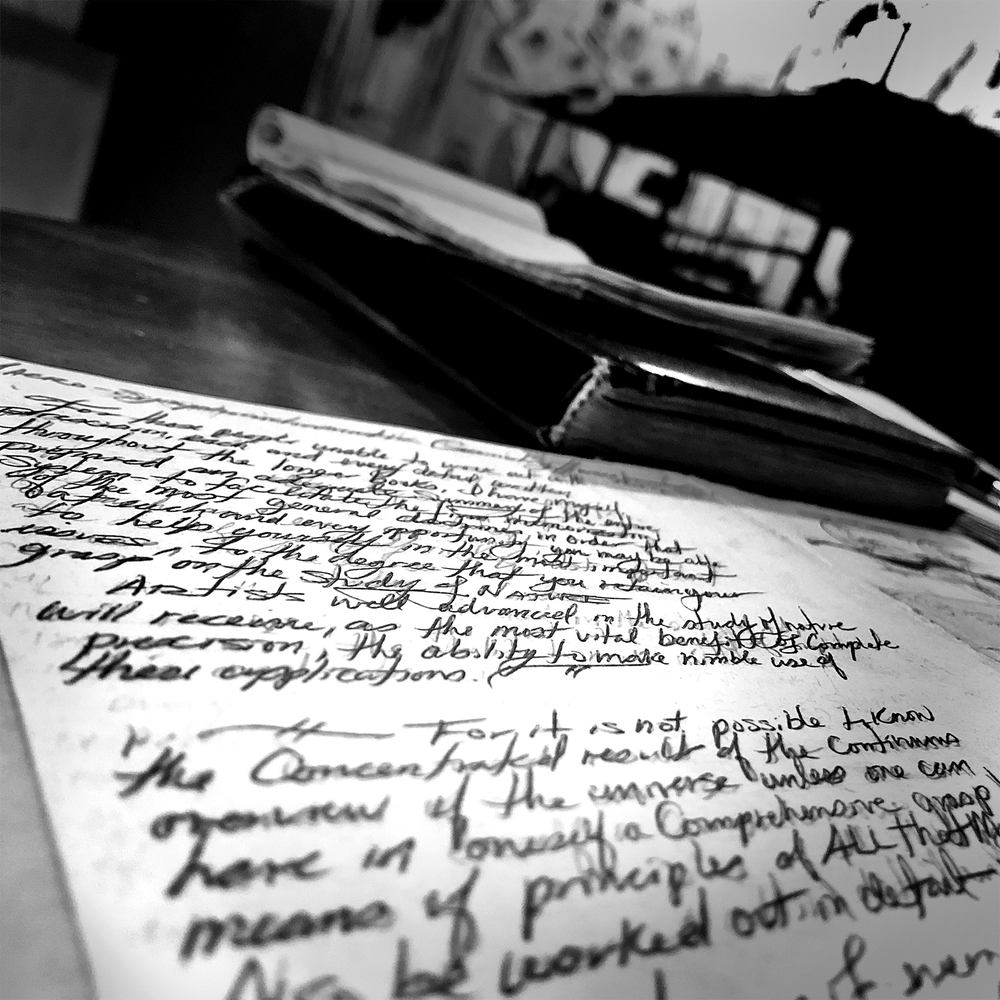
Hoppe attended the Maryland Institute College of Art and Syracuse University. At Syracuse, the dean of the Visual Arts department took a special interest in him and encouraged him to follow a self-taught path. Stone Canoe, published by Syracuse University Press, records what followed: five years isolated in a small studio deep in the birch forest at Powder Mill Park in Victor, New York, where he wrote twenty four books of theory on Art.
Those years established the foundations of CR1, a shared language that aligns the twelve colors, twelve musical notes, geometry, and natural numbers. The purpose was practical: musicians inherited a functional language for relationships, while visual artists inherited disconnected rules. Hoppe wanted a system that could be used, tested, taught, and expanded.
From 2000 to 2017 he built and creatively directed Dorian Orange, a New York motion design studio. There he tested these ideas at commercial scale, composing color and sound from a common value for projects involving Mercedes-Benz, Adidas, Samsung, Ford, Elle, and Coca-Cola. The studio became a laboratory where theory had to survive deadlines, technology, collaboration, and public space.
His studio practice moves freely between finely detailed graphite drawing, large abstract color painting, handwritten theory, teaching plates, and physical instruments. Forty nine theory volumes are complete, with the fiftieth in progress. The variety is deliberate. Hoppe is less interested in maintaining a recognizable style than in learning when logic should lead, when feeling should take over, and how an artist can move between the two.
Recent projects turn that research outward. The Ascending Numbered Edition tests a public rule for producing and pricing editions. What do you see? records how differently people perceive the same drawing. Both experiments ask the viewer to become part of the work.
Hoppe has exhibited in New York, Atlanta, Rochester, and Buenos Aires, and has lectured on the relationship between color, music, and geometry. He lives and works in Atlanta.
LISTEN
The Geometry of Thinking
Logic, creativity, and control.
Hoppe describes a creative process that moves between construction and intuition, then explains why the structure inside a thought can be identical to the structure inside a picture.
Read the full transcript