The principles of the Ascending Numbered Edition

The Staircase
and the Landing

A public pricing and production framework that lets an artist test demand without financing a warehouse full of prints or quietly discounting an edition later.

Instead of printing an entire edition and hoping buyers arrive, the artist opens one small flight, publishes the whole rule in advance, lets each placement help fund what comes next, and keeps the record visible.

Small first riskPrint only the first flight.
Public rulePublish every number and price before selling.
Permanent recordKeep placements and outcomes visible.
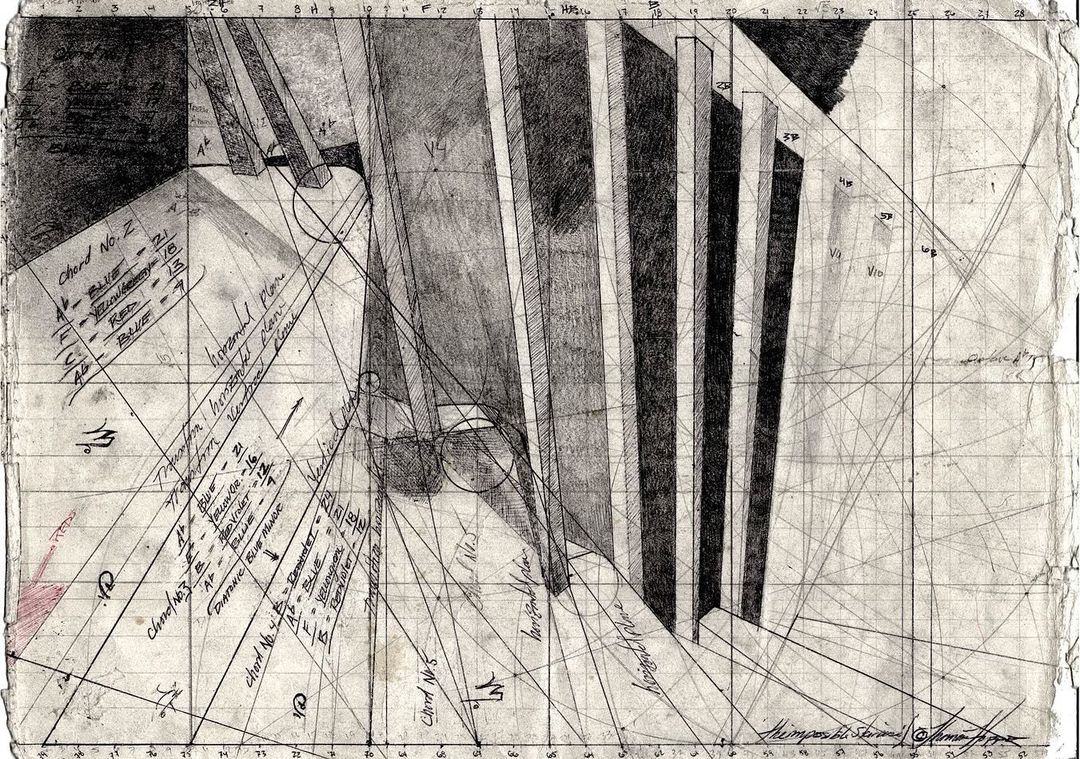
Graphite staircase construction study with numbered steps, landings, measurements, and geometric notes by Tommy Hoppe.
The staircase began as a drawn structure: steps, intervals, measurements, and landings made visible before they were translated into a public edition rule.

The problem

Why the ordinary edition feels backwards.

A conventional edition often asks the artist to pay for the full run before knowing how much of it the world wants. Every number usually costs the same, even though the first buyer moves with the least reassurance and later buyers act after demand is visible.

Capital first

The artist finances every print before the market has answered.

Inventory second

Unsold paper can sit, fade, bend, disappear, or become an awkward reason to discount.

The record last

Years later, even the artist may not know where each number went or whether it still exists.

The production rule

Risk one flight, not the whole staircase.

Begin with the amount you can afford to test. If $100 produces four or five archival prints, that small group becomes the first flight.

1

Choose a bounded test

Decide the maximum production amount you are willing to put at risk.

2

Print one flight

Produce only the small group that amount can responsibly buy.

3

Let No. 1 cover the flight

Set the opening price to recover the disclosed production cost of that flight, including a realistic buffer for proofing, packaging, and fees.

4

Let later placements build the next

Nos. 2, 3, and onward create the capital for the following flight instead of replenishing losses from an oversized run.

5

Stop at the landing

Do not print the next flight until the published production condition has been met.

6

Keep the ledger public

Record every number, price, placement, proof, and status where everyone can read it.

Graphite study of a single staircase flight between two landings by Tommy Hoppe.
01 · FlightBegin with the small run that the opening capital can responsibly produce.
Graphite architectural drawing of a staircase flight, turning landing, and upper flight by Tommy Hoppe.
02 · LandingStop, reconcile the published trigger, and change direction only by the rule already disclosed.
Graphite drawing of a long staircase divided into multiple flights and landings by Tommy Hoppe.
03 · StaircaseRepeat the process so later placements can fund later flights without manufacturing the whole edition first.
The rule that makes the experiment credible: the prices, production triggers, proof count, and landing formula must be published before the first sale. A landing can change the math only in the way the original public rule already permits.

The price rule

Every number is a position in the record.

The image repeats. The position does not. Prices rise gently inside each flight. At a landing, the next flight opens according to a larger, already-published step.

First flight opens at $130
No. 01$130
No. 02$150
No. 03$170
Landing: $130 + $150 + $170 = $450
Second flight opens at $450
No. 04$450
No. 05$470
No. 06$490
Landing: $450 + $470 + $490 = $1,410
Third flight opens at $1,410
No. 07$1,410
No. 08$1,430
No. 09$1,450

This is the published schedule for the Stradivarius pilot at Convergence. Different editions may use different mathematics, but the complete rule must be visible before sales begin and must not move downward after opening.

Why it helps

The experiment is bounded by design.

Production discipline

A larger edition can be produced one flight at a time instead of all at once.

Less physical waste

Fewer unneeded prints wait in storage where paper can be damaged or lost.

Demand discovery

The artist learns where buyers act without cutting an already-published price.

Early-mover logic

The first buyer accepts the greatest uncertainty and can claim the lowest published position.

Collector choice

A collector may select any currently offered position rather than waiting for lower numbers to move.

Verifiable provenance

One ledger shows the edition size, prices, proofs, placements, and final outcome.

The Convergence pilot

A fixed-price strategy, not an auction.

All twelve Stradivarius impressions already exist: nine are offered and three artist’s proofs are held. Any available offered number may be claimed at its published price.

The closing rule

At the close of Convergence on August 27, 2026, the registered holder of the highest placed number among Nos. 1 through 9 receives every offered numbered print that remains unplaced, at no additional purchase price.

What this means

A collector can deliberately choose a higher position. There is no bidding, no auctioneer, and no price negotiation. The published list does not change.

What this does not mean

The system does not promise appreciation, resale, liquidity, or a secondary market. It is a primary-sale and public-record mechanism, not an investment product or forecast.

One framework, two scales

The pilot proves the rule. Future editions can limit production.

Convergence

The Stradivarius run is intentionally small, so all twelve impressions already exist. It demonstrates the price staircase, public ledger, collector choice, and closing rule.

A scalable edition

An artist can publish a deeper staircase while physically producing only the current flight. The next flight is printed only when its pre-published trigger is reached.

Before the first sale

Publish enough that nobody has to trust a private explanation.

The objects

Edition size, offered numbers, artist’s proofs, materials, dimensions, and whether each impression already exists.

The money

Every fixed price or the complete formula, the size of each flight, and the rule at each landing.

The outcome

Production triggers, availability order, closing date, settlement rule, and how every change of status will be recorded.

The innovation is in the structure, not in any single ingredient. Tiered pricing, numbered prints, small-batch production, and public records all exist separately. The Ascending Numbered Edition makes them operate as one published system.